
 Basic UsageHeartThoraxTMPLeadsToolsFocusPreferencesCase FilesVersionsDownload case filesUpdate ECGSIMPublicationsLicense terms
Thorax
The thorax pane is used to display the geometry of the thorax and any of a
range of functions on its surface. You may rotate the thorax by right mouse
dragging, i.e. move the mouse while holding the right mouse button down.
You may go back to the standard frontal AP view (natural frontal view) by a
left double mouse click.
If a node on the thorax is selected, it is shown by a black dot on the surface.
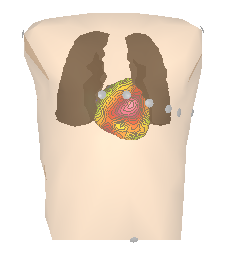
The electrode positions of the selected lead system (see leads) are shown as grey patches. The figure below shows the nine electrodes of the standard 12 lead system.
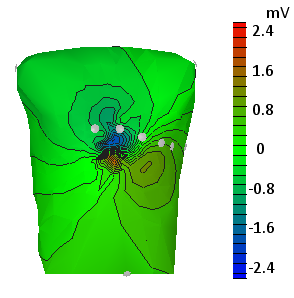
The contents of the thorax pane is copied onto the clipboard by selecting -Copy- from the main menu item -Edit- and then choose -Thorax-, or by pressing <Ctrl>-C while the mouse is within the thorax pane.
You may use the movie option to view the development in time of the activation of the heart as ... a movie.
Surface function
Default the geometries of the heart, lungs and thorax are shown. Additionally the body
surface potentials (BSPM) at the selected time can be shown or the sensitivity map (see
transfer function).
Body surface potentials can be displayed for the:
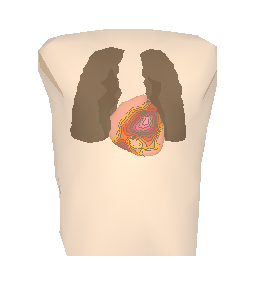
Is used to show a semi transparent geometry of the thorax. Within this thorax the same heart with equal selected surface function as shown in the heart view is being shown. Default the lungs are shown as well but this can be disabled. Is used to show the measured Body Surface Potentials Map. Is used to show the simulated Body Surface Potentials Map with initial parameter settings. Is used to show the simulated Body Surface Potentials Map with adapted parameter settings. Is used to show the sensitivity map on the thorax for a probed point on the heart. The sensitivity map can only be shown when a probe position is selected on the heart. In case no valid probe postion is determined no surface function is displayed on the thorax. A notification is also given in the statusbar.


When viewing a BSPM you may press the left and right arrow keys to step forward/backward in time. Alternatively, you may click in the TMP or in the ECGs view to select the time instant for which you wish the potentials to be displayed.
Show/Hide lungs
The lungs can be hidden by selecting this
 option in the -thorax- main menu item and shown again by unselecting this this same option,
now showing
option in the -thorax- main menu item and shown again by unselecting this this same option,
now showing  ,
again.
,
again.
Show/Hide electrodes
The electrodes on the thorax and heart can be shown by selecting this
 option on the toolbar or within the -options- main menu item and hidden again by unselecting this
same option, now showing
option on the toolbar or within the -options- main menu item and hidden again by unselecting this
same option, now showing  ,
again.
,
again.
Lock to heart
The orientation and rotation of the heart and thorax can be linked by selecting this
 option in the -thorax- main menu item. If this option is enabled rotating the heart will also rotate
the thorax in the same way and vice versa. Double clicking in the thorax or heart pane will restore the position
of both the thorax and heart to the initial position.
option in the -thorax- main menu item. If this option is enabled rotating the heart will also rotate
the thorax in the same way and vice versa. Double clicking in the thorax or heart pane will restore the position
of both the thorax and heart to the initial position.
Scale
The amplitude scale may be changed by scrolling with the mouse wheel or by the by the
arrow up and arrow down keys.
The arrow keys only work after the thorax pane has obtained the "focus" by
a mouse click in the thorax pane.
Movie
The movie option can be used to view the development of the potentials in time
as a movie. The movie may be started and stopped by pressing the play/stop button
in the toolbar.
The movie loops through the time starting at the beginning of the shown ECG signals up to the end of the shown signals (see leads). When the depolarization times are shown on the heart surface the movie shows the progression of the activation wave over the heart surface, both in the thorax pane and the heart view.

Mouse actions
select thorax node
This function is only available when a single lead ECG is shown in the
leads view or when the contribution map
is selected in the heart view.
A node at the thorax is selected by clicking with the left mouse button on the thorax
surface. The node nearest to the "click" is selected, as shown by a black patch on the
surface. Only one node may be selected at a time.
If you select another node, the previous one is deselected.
Display options
If you want to map a function on the thorax while also seeing through its surface, use iso function lines only.
For selecting any of the available color-codings see preferences.